
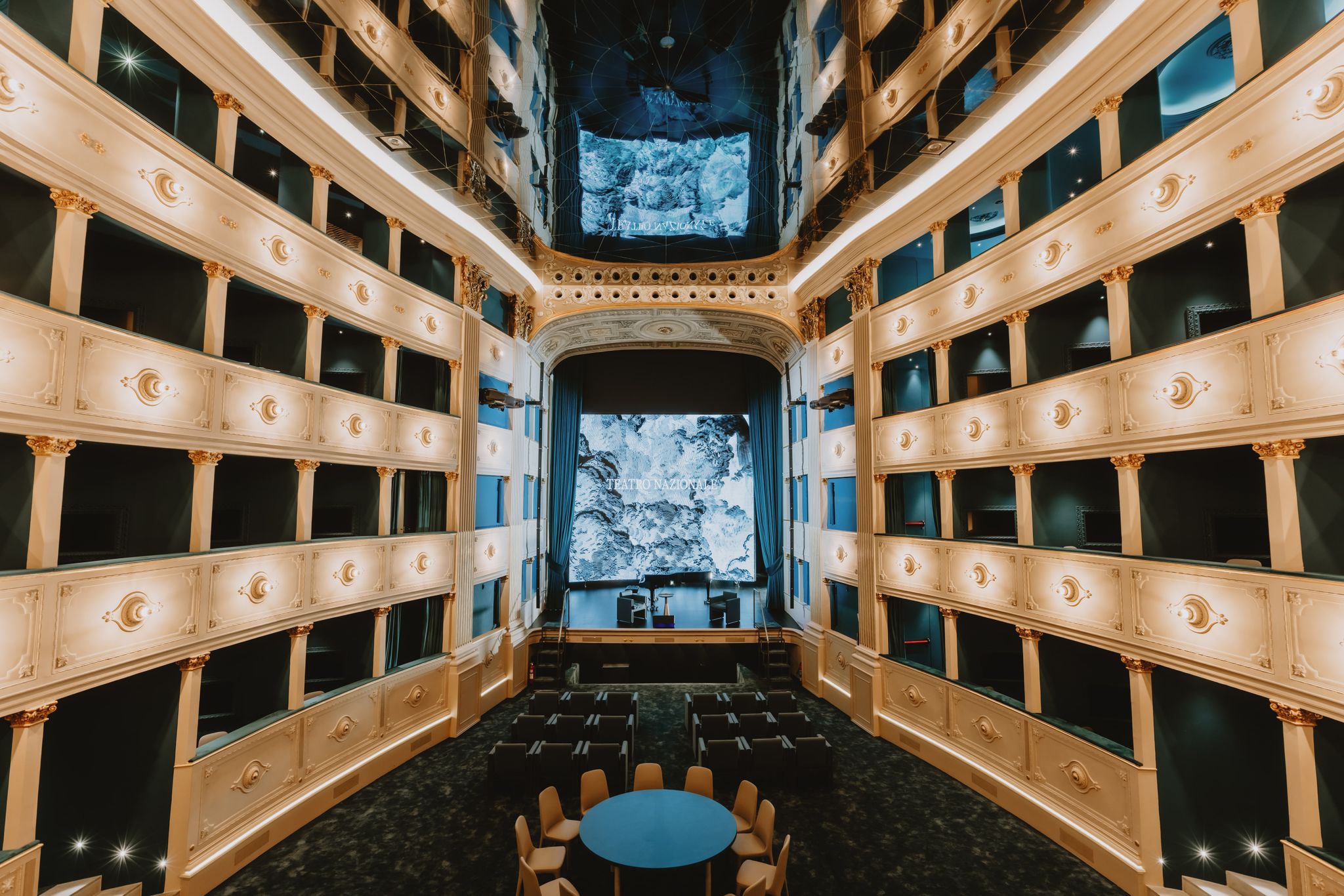
The restoration of Teatro Nazionale in Florence returns to the city a place that had stopped breathing for decades. Located on historic Via dei Cimatori and deeply connected to a tradition rooted in Florentine identity, the theatre now comes back to life not only through the recovery of its architecture, but through the possibility of resonating once again. Because a theatre truly exists only when voice, music, and performance once again travel through its space.
It is within this continuity between memory and future that the collaboration between Archea, Studio Sound Service, and K-array takes shape. A meeting point between architectural sensitivity, electroacoustic expertise, and technological innovation, where sound is not treated as an added element but as an essential component of the theatrical experience. The goal was not simply to introduce a new sound system, but to restore perceptual integrity to a historic space, elevating the quality of listening without altering its identity.
The Challenges of the Venue: Intervening Without Altering
The design challenge was particularly delicate. On one hand, it was necessary to preserve the aesthetic charm and natural acoustics typical of an Italian-style theatre: the intimate proportions of the hall, the rhythm of the boxes, the richness of the decorative elements, and the visual relationship between audience and stage. On the other hand, the project required the integration of a Dolby Atmos multichannel sound system, subject to strict constraints on loudspeaker placement, within a historic horseshoe-shaped space characterized by complex geometries.
In a context like this, sound quality is not a secondary aspect but the very foundation of the theatrical experience. The challenge to solve was therefore twofold: ensuring uniformity, intelligibility, and depth of listening across every seating area—from the front rows to the theatre boxes—while maintaining minimal visual impact. The technology needed to be highly performant while remaining perceptually discreet.
The Solution: A Synergy of Architecture, Acoustics, and Technology
The response to this complexity emerged from a closely integrated collaboration between Archea, Studio Sound Service, and K-array. Archea led the integration of the system while respecting the architectural balance of the hall; Studio Sound Service developed the acoustic and electroacoustic design, supporting the project through dedicated simulations and precise final tuning; K-array provided a loudspeaker ecosystem capable of combining directivity, precision, frequency extension, and minimal visual impact.
The shared principle was clear from the beginning: make the technology present in performance, not in appearance. In other words, to create a sound infrastructure capable of dialoguing with the space without altering its character, respecting its proportions and preserving the perceptual harmony of the environment.
The Installed System
At the heart of the project is a sound system designed to deliver an immersive, uniform, and controlled listening experience, reproducing the full frequency spectrum—from 20 Hz to 20 kHz—with clarity and spatial coherence.
The installed configuration includes:
Main System: two columns composed of 6x Python-KP102 I, positioned on either side of the proscenium, ensuring defined, deep, and precisely controlled sound projection.
Low-Frequency Management: 2x Thunder-KS4PI, strategically placed in the orchestra pit or within the first tier of boxes, providing body and extension without compromising the balance of the hall.
Front Fill: 3x Kobra-KK52 I installed horizontally along the stage edge and concealed beneath the frame, ensuring maximum intelligibility in the front rows with almost no visual impact.
Immersive Surround System: KGEAR GH4 loudspeakers complemented by 4x Rumble-KU210, positioned on the floor near the Ls2, Rs3 and Lr, Rr zones, reinforcing sonic envelopment, spatiality, and the overall immersive effect.
How the Project Solved the Challenge
Every decision was calibrated to address a specific challenge of the venue. The ultra-slim line array columns—one of K-array’s distinctive signatures—allowed the system to maintain a minimal visual presence, ensuring that attention remains focused on the stage rather than on the technical infrastructure. The front fill systems solved intelligibility issues in the front rows without altering the stage edge or introducing elements that could interfere with the architectural reading of the space. Low-frequency management, particularly delicate in a compact historic theatre, was addressed through strategic placement and compact high-performance components capable of delivering energy and depth without overwhelming the environment.
The surround configuration, finally, made it possible to integrate the immersive language of Dolby Atmos into a venue that was not originally designed to host this type of technology. This represents one of the project’s most significant achievements: allowing the complexity of contemporary audio reproduction to coexist with the balance, delicacy, and spatial quality of a historic theatre.
A New Standard for Historic Theatres
The result is a system in which architecture, acoustics, and technology function as a single organism. Teatro Nazionale is no longer just a restored venue; it is a space that fully returns to life, capable of delivering a precise and immersive sonic experience consistent with its identity. A theatre where sound becomes invisible architecture—a discreet yet decisive presence capable of shaping perception, sustaining emotion, and placing the audience at the center of the scene. Thanks to the synergy between Archea, Studio Sound Service, and K-array, Teatro Nazionale in Florence now stands as a new benchmark for interventions in historic theatres: a place where memory continues to speak, enhanced by technology that does not impose itself, but instead serves the performance, the space, and the city.


